Fear of heights and paragliding: a guide to taking the plunge
Trust in Delta Evasion’s reputation
Share this article:
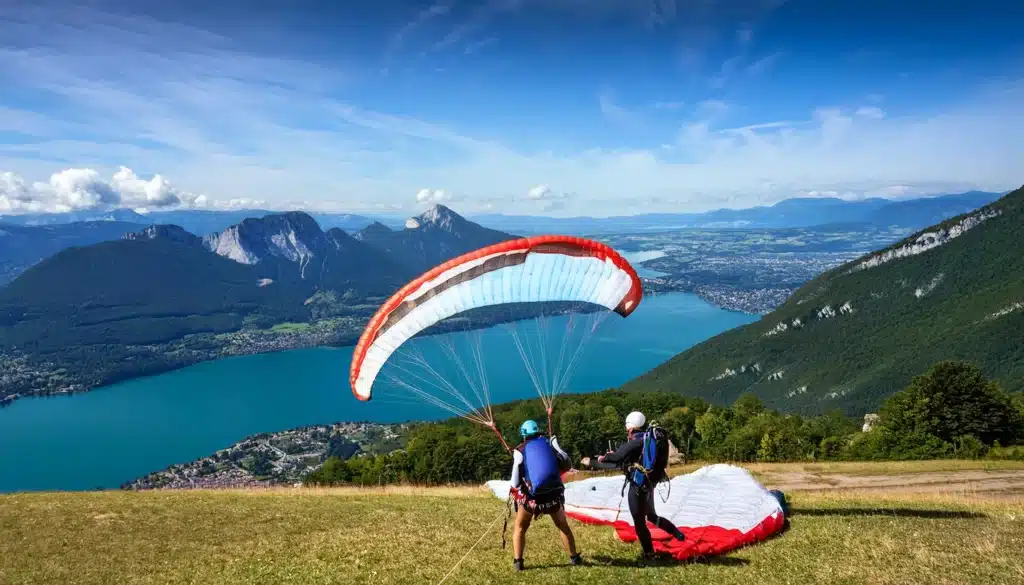
Let’s be honest: standing on the runway, feeling the wind on your face, and gazing at the horizon while knowing you’re about to take off… it’s pretty intense. It’s actually normal to feel butterflies in your stomach. If you’re feeling nervous, know that you’re not alone. The fear of heights is an ancient survival instinct.
But here’s the secret: this fear is often based on a physiological misunderstanding. By staying grounded, you’re missing out on a sense of absolute freedom, a silence that only the sky can offer. What if your brain were lying to you?
Lorem ipsum dolor sit amet, consectetur adipiscing elit. Ut elit tellus, luctus nec ullamcorper mattis, pulvinar dapibus leo.
Why are we afraid of heights? (And how does it differ from vertigo?)
Acrophobia (the fear of heights) is often confused with vertigo. However, scientifically speaking, they are two entirely different things.
Vertigo is a sensory conflict. Your inner ear detects balance, but your eyes, focused on the ground below (such as when you’re at the top of a ladder or on a balcony), send a signal of imbalance. The result: your brain panics, your legs feel like jelly, and your head spins.
Acrophobia, on the other hand, is a psychological fear linked to the anxiety of falling. The good news? Paragliding is the best remedy for both. Why? Because to feel dizzy, your feet have to be on the ground.
Paragliding and the fear of heights: why you won't feel dizzy while flying
That’s the killer argument—the one that puts 99% of passengers at ease: you never get dizzy when paragliding. Once your feet leave the ground, the physical connection to the earth is broken. Your inner ear no longer tries to orient itself relative to the immediate terrain. You’re not on a tightrope above the chaos; you’re carried by a mass of air.
Forget the image of a skydiver jumping into the void. With paragliding, you don’t jump—you glide. You’re comfortably seated in a harness (a heavily padded seat), snugly tucked in. It’s stable, it’s smooth, and above all, it’s very reassuring.
The absence of visual cues: the key to comfort
The brain is unable to calculate pure vertical distance without a reference point rising from the ground (such as a wall or a pillar). At an altitude of 600 meters, the ground becomes a magnificent 2D postcard. Since there is no straight line between your eyes and the terrain, the sensation of falling disappears completely. It’s quite paradoxical: the higher you are, the less afraid you are (much like on an airplane).
Wing stability: Overcoming the fear of losing balance
Some people imagine that paragliding is unstable, like riding a bike through a turn. Wrong. The pendulum-like structure of the paraglider (your weight is positioned well below the wing) makes it one of the most stable aircraft in the world. It’s a true “flying chair.” If you let go of everything, the wing continues to fly straight.
5 Practical Tips for Overcoming Your Fear Before Your First Flight
The instructor isn't just there to fly; they're your in-flight counselor. Our pilots are experienced in handling all levels of stress. Even before takeoff, they'll take the time to explain the technique, check your equipment, and make sure you're ready.
During a first flight, the pilot adjusts his flying style. If you’re nervous, he’ll maintain a smooth flight path and avoid sharp turns. His goal? For you to finish the flight with a huge smile and the desire to do it again.
Breathe from your abdomen: As soon as anxiety starts to rise during takeoff, force yourself to exhale slowly. It calms the nervous system instantly.
Choose the morning flight: The air is calm and “smooth,” with no turbulence. It’s the perfect session for a gentle first-time experience.
Look toward the horizon: When taking off, don’t stare at your shoes. Look far ahead, toward where you’re going. The brain loves perspective.
Talk to your instructor: Don’t keep your stress to yourself. Talking about your fear is already half the battle.
Have a bite to eat: Going out on an empty stomach makes stress-related discomfort worse. A light snack will work wonders.
The instructor's role: personalized support for those with anxiety
The fears that prevent us from taking action
We often hear people say things like, “I can’t do that—I’m too scared of…” or “I’m not capable of it; just imagine if something like that happened to me up there.” In reality, fear is just in your head, and it’s created by preconceived notions.
Do we lose altitude during takeoff?
Absolutely not. You don't just jump into the void, and you don’t “jump” when paragliding. You run down a gentle slope, the wing inflates above you and carries you. It feels like you’re being lifted gently from the hips; it’s very gradual.
What happens if I have a panic attack while in the air?
This is extremely rare, because the act of flying keeps your mind occupied. But if it does happen, the instructor is trained to handle it. They can land the paraglider in just a few minutes and use communication techniques to help you calm down.
Paragliding as a treatment for acrophobia
This is what’s known as exposure therapy. By exposing yourself to heights in a completely safe and comfortable environment, you teach your brain that “high” doesn’t mean “dangerous.”
Ready to trade your fear for an unforgettable memory?
If you still have any questions, feel free to stop by the launch site to watch a few takeoffs, or come directly to one ofour meeting points. You’ll see, the hardest part is deciding to get in the car!